
Rotary Drum Granulator | EMCC Fertilizer Granulation Equipment

Rotary Drum Granulator Product Overview
The Rotary Drum Granulator is a core granulation equipment widely used in industries such as fertilizer, feed, mining, and chemicals. It efficiently converts powdered materials into uniform, spherical granules through the rotating action of the drum, making it the preferred choice for high-capacity granulation production lines.
Applicable Materials & Fertilizer Types
EMCC Rotary Drum Granulators are suitable for:
▢ Inorganic Fertilizers granulation: NPK compound fertilizer, diammonium phosphate (DAP), monoammonium phosphate (MAP), superphosphate, potassium chloride, potassium sulfate, etc.
▢ Organic Fertilizers granulation: Humic acid, bio-organic fertilizer, livestock and poultry manure fermentation products, etc.
▢ Other Materials granulation: Mining powders, chemical raw materials, etc.
Production Capacity Range
As a high-capacity granulator, the Rotary Drum Granulator’s capacity covers everything from laboratory testing to industrial-scale mass production, with a single-unit processing capacity ranging from:
▢ Minimum: 0.5 tons/hour
▢ Maximum: Over 90 tons/hour
Customized designs are available to match fertilizer production lines of different scales based on customer requirements.
Applicable Materials & Fertilizer Types
EMCC Rotary Drum Granulators are suitable for:
▢ Inorganic Fertilizers granulation: NPK compound fertilizer, diammonium phosphate (DAP), monoammonium phosphate (MAP), superphosphate, potassium chloride, potassium sulfate, etc.
▢ Organic Fertilizers granulation: Humic acid, bio-organic fertilizer, livestock and poultry manure fermentation products, etc.
▢ Other Materials granulation: Mining powders, chemical raw materials, etc.
Production Capacity Range
As a high-capacity granulator, the Rotary Drum Granulator’s capacity covers everything from laboratory testing to industrial-scale mass production, with a single-unit processing capacity ranging from:
▢ Minimum: 0.5 tons/hour
▢ Maximum: Over 90 tons/hour
Customized designs are available to match fertilizer production lines of different scales based on customer requirements.
Rotary Drum Granulator Working Principle & Core Advantages
During operation, powdered materials enter the inclined rotating drum via the feeding device. As the drum rotates, the materials gradually agglomerate into granules through rolling, friction, and the action of an external binder (water, steam, or other liquids). Under the combined forces of gravity and centrifugal force, the formed granules move along the drum wall to the discharge port and are expelled.

✅︎ High Granulation Rate: High sphericity, round and uniform granules
✅︎ Low Energy Consumption: More energy-efficient compared to other granulation methods
✅︎ Strong Adaptability: Handles various materials, supports wet granulation and chemical reaction granulation
✅︎ Easy Operation: Stable operation, high degree of automation
✅︎ Convenient Maintenance: Reliable structure, few wear parts
EMCC Customization Drum Granulator Capabilities
EMCC offers full-parameter custom design based on different process requirements, including:
Need a custom solution or detailed parameters for your material?
EMCC Customization Drum Granulator Capabilities
▢ Drum speed and inclination adjustment
▢ Binder spray system (multi-point liquid distribution, atomization control)
▢ Support for PLC automation control, integrated with complete line interlocking
▢ Drum liner materials (wear-resistant, anti-corrosion, anti-stick)
▢ Optional installation of baffles to enhance mixing effect
Need a custom solution or detailed parameters for your material?
EMCC Rotary Drum Granulator Technical Specifications
A – Cylinder
B – Feeding device
C – Discharging device
D – Support wheel assembly
E – Transmission
F – Protecting cover
G – Spray pipe assembly
H – Rolling ring
J – Big gear
K – Pinion
L – Supporting wheel
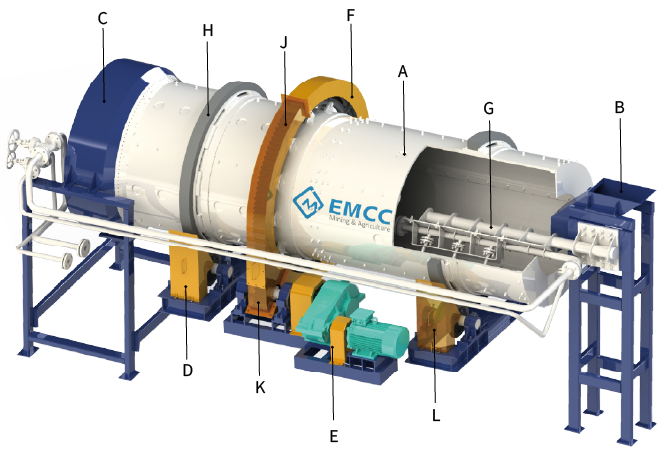
Basic Technical Parameters Table
Model Specification (m) | Inner Diameter (mm) | Drum Speed (r/min) | Capacity (t/h) | Motor Power (kW) | Weight (t) |
Min Φ0.8×3.0 | 800 | 20.0 | 0.5-1.5 | 1.1 | 2 |
Max Φ4.5×8.0 | 4500 | 8.0 | 30-90 | 280 | 180 |
Max Φ4.5×8.0
280
180
The above are the minimum and maximum basic parameters for EMCC Rotary Drum Granulators. For specific parameters, design drawings, or a quote tailored to your material, please 【Contact EMCC Engineer】 or 【Visit Official Website for Complete Cases】 .
Related Equipment
● Supporting equipment: Crusher, Mixer, Elevator, Belt Conveyor
● Supporting environmentally friendly dust removal equipment: Pulse Dust Collector, Spray Tower
● Thermal equipment: Boiler, Combustion Device
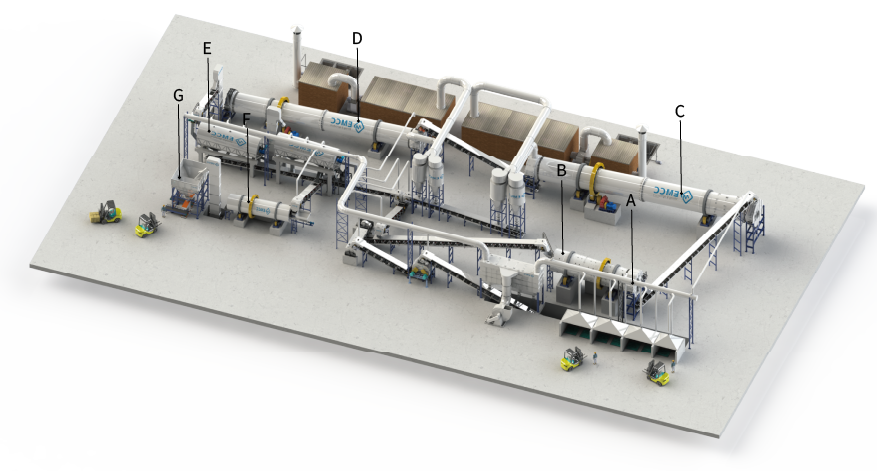
Fertilizer raw material batching → Pretreatment and crushing → Mixing → Granulation → Drying → Cooling → Screening and recycling → Coating → Packaging → Finished product.
For specific parameters, design drawings, or a quote tailored to your material, please 【Contact EMCC Engineer】 or 【Visit Official Website for Complete Cases】 .
Technical Deep Dive
The following content details the advantages of Rotary Drum Granulators in fertilizer production and the process pathways. For specific parameters, design drawings, or a quote tailored to your material, please 【Contact EMCC Engineer】 or 【Visit Official Website for Complete Cases】 .
Why choose a Rotary Drum Granulator for fertilizer?
In fertilizer production, granulation is a key technology for converting powdered raw materials into granular multi-nutrient fertilizers. It significantly improves bulk storage and packaging quality, while greatly enhancing handling efficiency and application convenience.
As the core equipment for this process, the Rotary Drum Granulator—with its stable operation, robust structure, and strong adaptability—has become the preferred solution for the global fertilizer industry to meet diverse and ever-changing market demands. EMCC Rotary Drum Granulators cover a wide range of categories from organic fertilizers to high-concentration compound fertilizers, meeting different customer capacity and process requirements.
How Does a Rotary Drum Granulator Produce High-Quality Fertilizer Granules?
In a Rotary Drum Granulator, a granule is defined as a solid spherical pellet within the size range of approximately 1–6 mm in diameter. Their physical properties and chemical composition can be flexibly adjusted according to application requirements.
Typical Process Pathways:
▢ NPK Compound Fertilizer Granulation: Nitrogen (N), phosphorus (P), and potassium (K) typically enter the equipment as fine powder and can either:
● Be directly granulated into an integrated compound fertilizer
● Be granulated separately and then blended in proportion to achieve a customized nutrient formula
▢ DAP Granulator / MAP Granulator: In the production of diammonium phosphate (DAP) or monoammonium phosphate (MAP), the Rotary Drum Granulator not only completes granulation but also continuously participates in the chemical reaction. The reaction, initiated in a pre-neutralizer tank, neutralizes the phosphoric acid slurry with ammonia, simultaneously generating solid granules containing both phosphate and nitrogen.
▢ Functional Granule Production: By using different liquid binders and surface coating technologies, the following can be produced:
● Slow-release / controlled-release fertilizers
● Multi-layer structured granules (by adding different minerals at various stages of the granulation process)
Rotary Drum Granulator Design: From Standard to Custom
The structural principle of a Rotary Drum Granulator is relatively straightforward—raw material enters the rotating cylinder, binder is added, and the material tumbles to form granules. However, to achieve stable production of high-quality granules at high capacity, professional design capabilities and in-depth process understanding are essential.
We not only provide reliable products, but more importantly, we provide reliable process design and experimentation.
EMCC Focuses on the Following During the Design Phase:
● Is the material organic or inorganic?
● What is the target nutrient content?
● Which binder will achieve the desired slow-release effect while also preventing degradation during storage and transport?
Key Design Parameters:
● Capacity: Determined based on customer requirements, usually measured in tons per hour (TPH)
● Inclination: Precisely matched to ensure the material forms the ideal “cascading” state within the drum
● Speed: Too slow causes material accumulation at the bottom; too fast causes material to adhere to the drum wall due to centrifugal force
The following content elaborates on how testing ensures the feasibility of the granulation process and equipment performance. For testing services tailored to your material, please 【Visit Official Website for Testing Center】 or 【Contact Engineer to Schedule Material Testing】 .
Why is Testing So Important?
Conducting material testing at the EMCC Innovation Center allows you to:
✅︎ Confirm the feasibility of the intended process
✅︎ Identify potential issues before scale-up
✅︎ Collect key process data required for equipment design
✅︎ Reduce project risks and avoid later operational failures and production losses
📌 Note: “Granulation” here specifically refers to wet granulation (also known as agitation agglomeration, tumble-growth agglomeration, or non-pressure agglomeration).
How Does Testing Impact Rotary Drum Granulator Design?
A comprehensive testing program provides the following core values:
1️⃣ Assessing the Material's Unique Response to Granulation —— Raw material characteristics that affect granulator design include:
▢ Particle size distribution, bulk density, moisture content
▢ Temperature (in some cases)
▢ Chemical composition
▢ Ease of granulation
▢ Abrasive or corrosive nature
▢ Special requirements (heat sensitivity, toxicity, etc.)
2️⃣ Gathering Key Process Data
Optimal granulation is achieved by controlling granule formation through a matrix of process parameters based on material behavior. Key data points focused on during testing include:
Parameter | Function |
Binder and material feed rates | Affects granule growth speed and uniformity |
Percent fill | Determines equipment size and capacity matching |
Retention time | Ranges from 30 seconds to 60 minutes, affects granule density |
Drum speed and inclination | Determines the “cascading” state of the material, affects sphericity |
Spray system design | Determines binder distribution uniformity |
Pretreatment requirements | Determines whether front-end processing equipment is needed |
3️⃣ Identifying Potential Issues and Mitigating Risks Early
Materials successfully granulated on a batch/bench scale often present unpredictable issues upon scale-up. Pilot-scale testing can identify these issues early, allowing engineers to adjust the design before equipment fabrication, avoiding later modifications and losses.
Additionally, testing helps operators gain an in-depth understanding of material characteristics, accelerating future troubleshooting, such as identifying process fluctuations caused by raw material anomalies.
Rotary Drum Granulator Frequently Asked Questions (FAQ)
1. What data is needed to design a Rotary Drum Granulator?
Raw material data (composition, moisture, temperature, bulk density, etc.), product data (particle size distribution, density, etc.), and process/environmental data (materials of construction, electrical controls, temperature and humidity, altitude, etc.). Most data is obtained through material testing.
EMCC provides complete process data collection services for customers.
2. How do I know if a Rotary Drum Granulator is suitable for my application?
It depends on capacity, granule quality requirements, and process conditions.
The most reliable method is to conduct material testing to directly verify granulation effects and equipment compatibility.
【Schedule Material Testing】 or 【Submit Process Parameters for Preliminary Assessment】
3. What is the rotary drum granulator retention time?
Generally between 30 seconds and 60 minutes, depending on the process goals.
Retention time affects granule formation quality and is typically determined through preliminary testing.
EMCC determines the optimal retention time for customers through upfront material testing.
4. What auxiliary equipment is needed for a Rotary Drum Granulator?
Typically requires feed and discharge systems, screening and recycle systems (to return off-spec granules back to the process).
A dryer is usually installed downstream, and sometimes a mixer is installed upstream to ensure uniform feedstock.
5. Can the Rotary Drum Granulator be automated?
Yes.
It can be equipped with a Programmable Logic Controller (PLC) and Motor Control Center (MCC) for automation, allowing parameter adjustments and data collection via a Human-Machine Interface (HMI).
6. What is the design process for a Rotary Drum Granulator?
7. Does the product exiting the granulator require drying?
Yes.
Because the granulation process requires adding liquid binders, the discharged material is wet and generally dried using a rotary dryer.
During drying, granules are further rounded and “polished.”
EMCC offers complete production line packages including granulation, drying, screening, cooling, and packaging.
8. What are typical wear parts?
9. What are the advantages of a Rotary Drum Granulator over a disc pelletizer?
10. Is the Rotary Drum Granulator batch or continuous?
11. How to prevent caking in drum granulator?
Caking is usually caused by excessive moisture, improper temperature, or deviations in operating parameters. Solutions include installing self-cleaning liners or scrapers, reducing water spray volume, increasing recycle material, adjusting speed and inclination, enhancing cooling, and applying anti-caking agents if necessary.
Details available in the original article >
12. Steam granulation vs. water granulation: what's the difference?
Steam granulation (hot method) produces higher hardness granules, achieves granulation rates above 90%, and has lower drying costs. It is suitable for large-scale, high-concentration fertilizers but requires boiler investment. Cold water granulation offers simpler equipment and lower investment, suitable for small to medium-sized lines or organic fertilizers, but results in higher granule moisture and slightly higher drying energy consumption.
Details available in the original article >
Why Choose EMCC
10+ Years Industry Experience
Dedicated to providing granulation, drying, cooling, and conveying solutions of various raw materials.
100+ Global Sucess Cases
Standardized service procedures and comprehensive after-sales ensure smooth project execution.
50+ Persons Design & Service Team
Access to consultation, design, machines, installation, training, on-site guidance, spare parts, and daily maintenance.
Dedicated to providing granulation, drying, cooling, and conveying solutions of various raw materials.
Integrated Steel Plate Fabrication
Max. drum-type equipment processing: Ø4.5 m, Robust structure and high-quality components extended service life.
Standard Service Process
Consultation > Trial Analysis > Solution Design > Quotation & Contracting > Equipment Fabrication > Assisted Installation & Commissioning > Ongoing After-sales Support